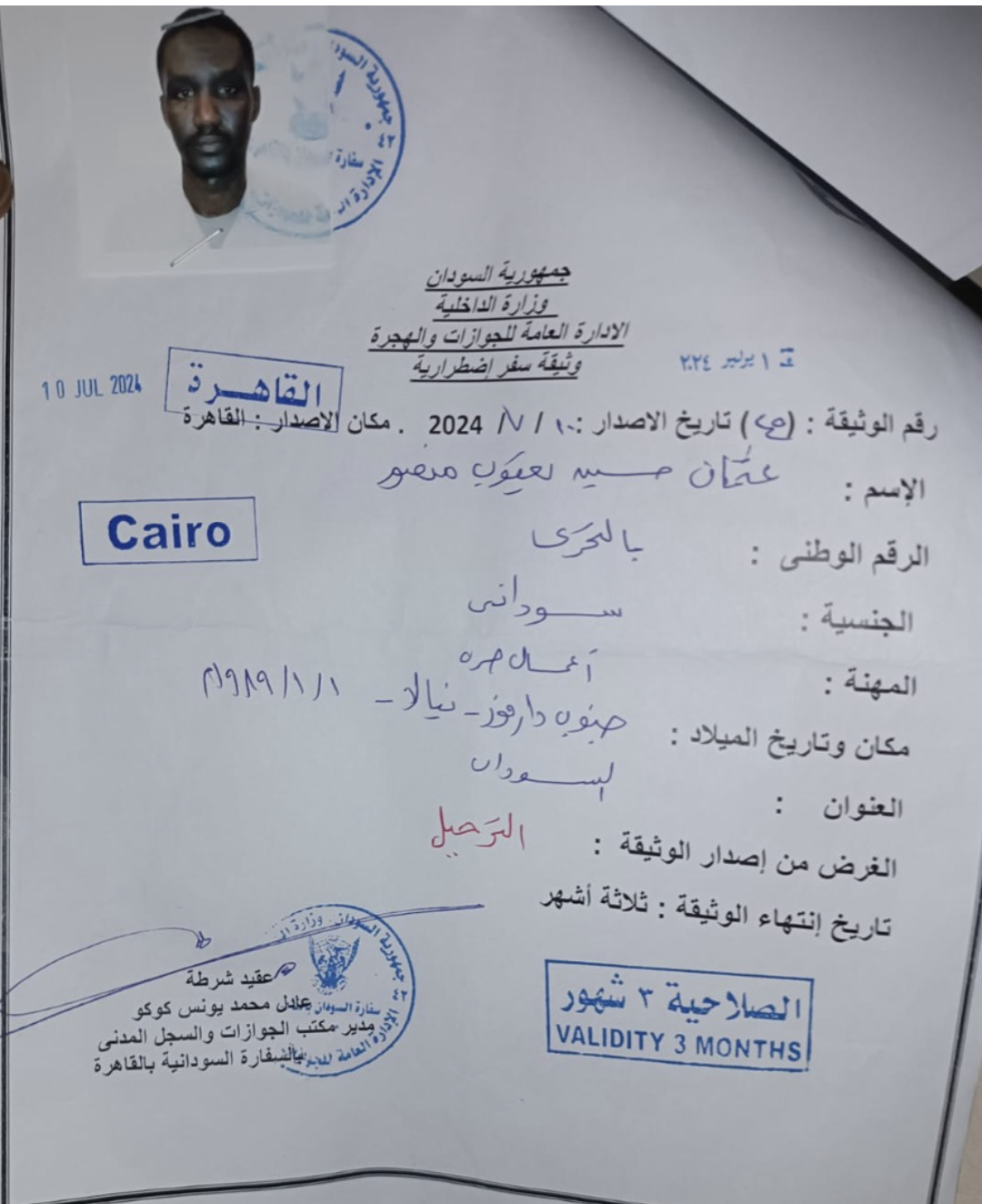
Last year’s investigation revealed that large-scale illegal deportations of thousands of Sudanese were secretly being carried out in violation of international refugee conventions that Egypt had long ratified. The investigation exposed the locations of the squalid facilities where security services were detaining people.
Follow-up reporting – based on newly obtained material from local refugee organisations, leaked Egyptian government documents, and testimonies from dozens of refugees and lawyers gathered over more than a year – reveals a further escalation in the deportation campaign.
Far more refugees are now being detained and deported, with security services carrying out sweeps and stops not only in border areas where people enter the country but deep inside major cities. Authorities have also targeted refugee-led initiatives, including by shutting down dozens of Sudanese-run schools.
The crackdown comes as the EU has pledged large sums to Egypt in exchange for it curbing migration to Europe – a deal mirroring similar agreements with other transit countries, and which risks making the bloc complicit in abuses by the Egyptian government, which did not respond to a request for comment.
UNHCR receives substantial funding from European governments, which critics say creates political pressure on the agency to avoid publicly criticising Egypt’s deportations and other policies that increase refugees’ vulnerability and limit the UN’s ability to support them.
Other sources accused UNHCR of being directly compromised by Egyptian security services. They said the agency’s operations were subject to pressure that led some staff members to bury refugee complaints or prevent reports of arrests and deportations from being escalated.
UNHCR spokesperson Babar Baloch said donors are critical to sustaining the agency’s activities, but its work “is guided by the fundamental principles of humanity, impartiality, neutrality, and independence”. He said the agency “regularly engages” with Egyptian authorities to raise concerns on violations affecting refugees.
“Given the ongoing brutal conflict in Sudan, UNHCR believes that people forced to flee Sudan are likely to be in need of international protection and, as such, should not be forcibly returned to their country,” Baloch said.
A “record number” of deportations
Even before the current war and displacement crisis, Sudanese and other refugee groups in Egypt faced deportations and other abuses by security services, including arrests and, in some cases, killings.
❯
Read more: Refugee protests and security crackdowns
For two decades, refugee protests in Egypt have been met with police raids, arbitrary detention, criminal charges, disappearances, and deportations. Here is a timeline of some of the worst incidents:
- 2005: Some 3,000 Sudanese refugees staged a sit-in outside UNHCR’s office in Cairo. Egyptian police violently cleared the camp, leaving dozens dead and many arrested or missing.
- 2019: Dozens of Eritrean refugees gathered at a UNHCR office in 6th of October city to demand action on long registration waits and deportation risks. Security forces fired tear gas and detained dozens. Five community representatives were later prosecuted, with families reporting a lack of action from UNHCR.
- 2020: After the killing of 12-year-old Mohamed Hassan, Sudanese refugees held condolence gatherings and small protests. Security forces raided both sites, used tear gas, and arrested dozens of community members. The child’s father was detained, beaten, and forcibly disappeared for two days before being released. Ten Sudanese community leaders – called to a police station by a lawyer contracted by UNHCR – were detained and later convicted for protests they said they did not attend.
- 2023: Chadian refugee and rights defender Djasnan Alfred Camus was kidnapped after his organisation published a social media post about a planned demonstration outside a UNHCR office. He was held incommunicado before being forcibly deported to Rwanda.
However, deportations began surging in late 2023, ahead of the Egypt-EU agreement and amid increased Sudanese arrivals. The trend then accelerated further after the adoption last year of Egypt’s first national asylum law. Though not yet fully implemented, sources said it emboldened authorities by granting them wide latitude to revoke refugee protections on vague grounds such as respect for undefined Egyptian values.
Accurate numbers of deportations are difficult to determine as the government does not give the UN and other humanitarian actors access to detention centres and border areas, and because it does not share any of its own data. Still, snapshots from local organisations supporting refugees hint at the scale of the crackdown.
In the first three months of this year, one prominent local refugee advocacy organisation reported a “record number” of deportations in an internal research document shared with reporters. Like many sources in this story, the group’s director requested anonymity – for both themselves and the organisation – due to the risk of government reprisals.
In total, the organisation documented over 850 deportations of mostly Sudanese refugees – already over half the 1,546 it recorded in all of 2024, a number that itself represents a fraction of the more than 20,000 Sudanese refugees likely deported last year.
The case archive of the Refugees Platform in Egypt, which includes incidents reported to it by refugees and lawyers, documented the detention of 687 Sudanese asylum seekers between April and August in three main areas – Greater Cairo, Alexandria, and Matrouh – and a further 1,560 who were detained and deported since August.
Reporters also gathered visual evidence of arrests and deportations. One geolocated and verified video shows a uniformed officer with a stick confronting refugees outside a UNHCR building in Cairo. Others show security forces carrying out arrests at police checkpoints and in residential areas.
Two Egyptian security officials described how deportations have become routine. One officer from Greater Cairo said his police station deports around 200 people weekly, while another said over 2,000 Sudanese are transferred weekly from police stations in Cairo to Aswan, a town near the Sudan border.
One Egyptian human rights activist described the scale of deportations as “unprecedented” in Egypt's recent history, while a senior official at an international NGO said refugee protection is “shrinking by the day”, trapping families between impossible choices: “Endure detention and deportation, or risk their lives trying to reach Europe.”
Legal protections erased
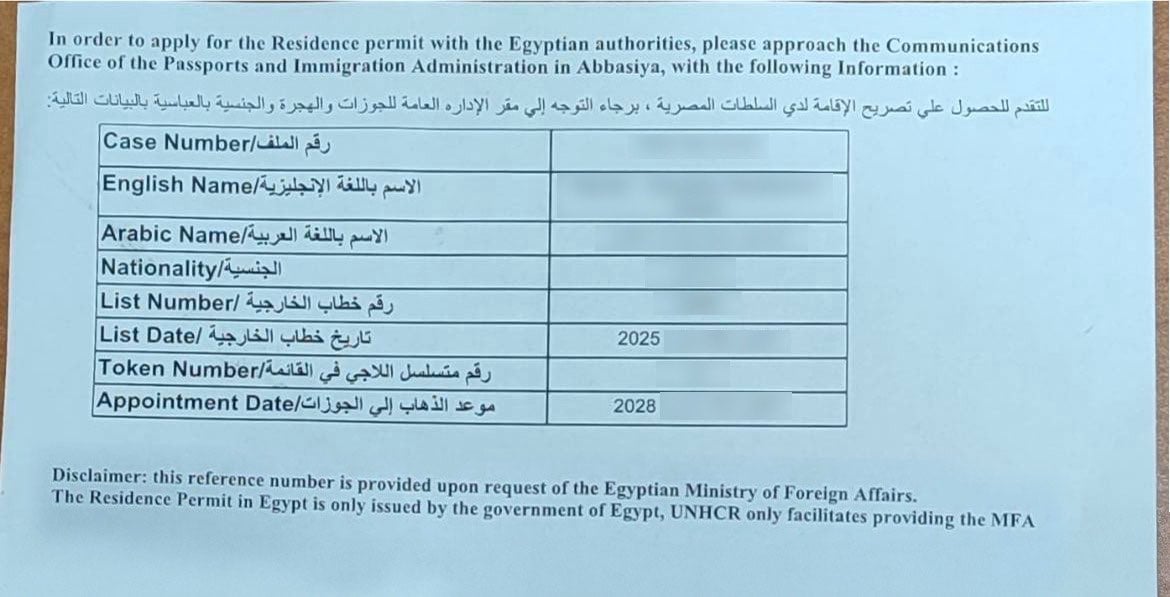
Most refugees who spoke to reporters said they were detained and deported for lacking a valid residency permit – a legal requirement that applies to all foreign nationals but which is difficult to meet for refugees because the government has massive registration backlogs, with some appointments pushed to 2029.
Refugees said they were also arrested and deported despite having UNHCR documents, which should protect them against refoulement. Some even described instances in which Egyptian authorities confiscated their cards at the time of arrest, thereby stripping them of proof of their protected status.
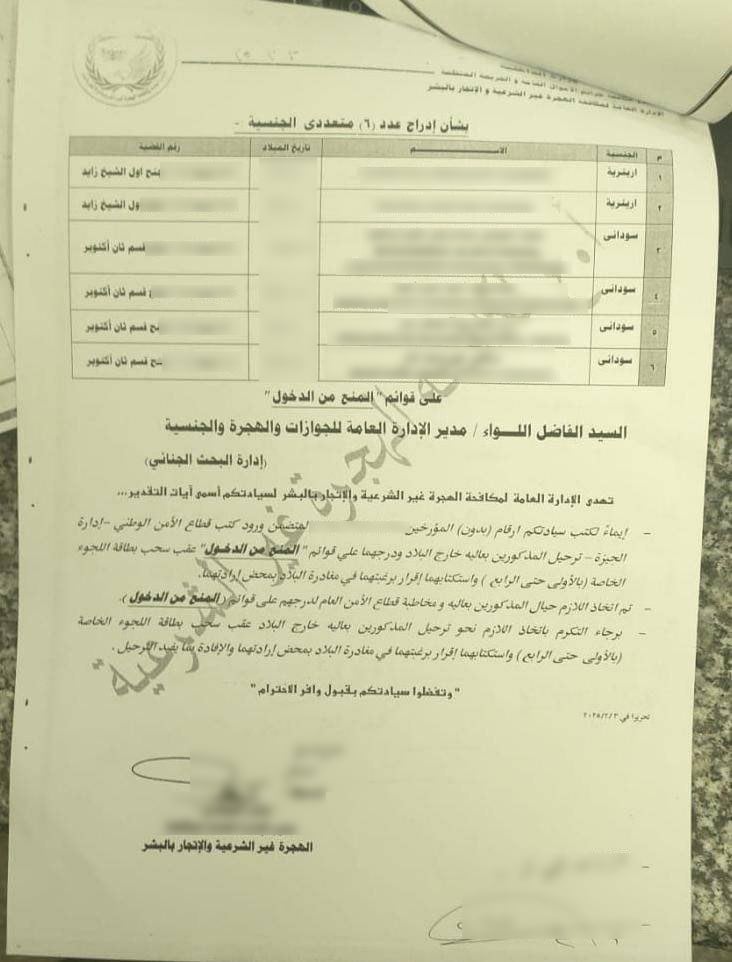
One government document obtained by reporters ordered the deportation of six mostly Sudanese refugees, four of whom were registered with UNHCR. The document instructed authorities to confiscate the UNHCR cards and ensure the refugees signed declarations affirming their “voluntary” departure.
While the confiscation of UNHCR cards and coerced “voluntary returns” have long been flagged by human rights groups in Egypt, the fact that it is recorded here in an official government document may indicate that these are not isolated abuses but part of a broader strategy.
“It is a systematic effort to erase their legal protections,” said a lawyer for a local refugee organisation who has worked on deportation cases in Egypt for over a decade. “Once the documents are taken, it becomes almost impossible for them to defend their right to stay.”
The director of the local refugee advocacy organisation said the situation has deteriorated because of the “blank check” the EU has provided to Cairo to curb irregular migration. They said the partnership has “given the Egyptian authorities complete freedom to violate their international obligations”.
The agreement may also have proved counterproductive, as the worsening environment for refugees has driven onward movement of Sudanese to Libya. While some remain there, reports suggest the number travelling to Europe jumped significantly in the first months of 2025.
During this period, hundreds of Sudanese attempting to reach Libya were also arrested, with detainees and their lawyers describing to reporters severe overcrowding; being held for months without due process, healthcare, and access to asylum; and ultimately being deported to Sudan.
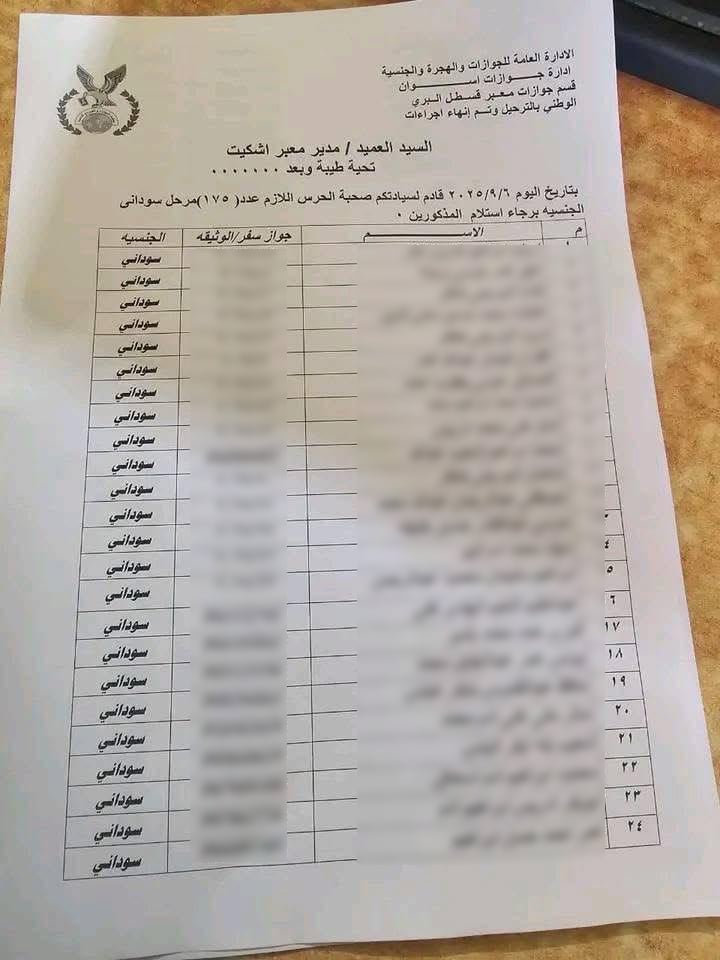
One internal document from Egypt’s ministry of interior showed that nearly 200 Sudanese, including women and children, were deported from Matrouh, a northern town near Libya, in a single day in September. Lawyers confirmed that such deportations occur regularly and likely involve far higher numbers.
Community leaders and children targeted
Last year’s investigation focused on refugees detained along the border after entering Egypt irregularly – necessary because visas take months to obtain – and while travelling onwards to Cairo. The latest cases show how the crackdown has spread into cities, with arrests at police checkpoints, metro stations, and in residential areas.
One Sudanese refugee said she was arrested in Cairo in January after police took her UNHCR document, leaving her without proof of status. Lacking residency papers, she said she was taken to a detention centre, where officers falsified her file to claim she had been caught near the border with no documents at all.
In January, authorities also deported a 17-year-old Sudanese boy who had registered with UNHCR and was living in Giza, according to a case shared by the refugee advocacy organisation. He was arrested on his way home from school for lacking a residency permit. His deportation five days later separated him from his parents.
In another recent incident, also shared by the refugee advocacy organisation, a 15-year-old Sudanese boy, who had lived in Egypt since infancy, was detained and deported after being arrested with a group of students who were celebrating their school graduation in a Cairo park. Despite at least two of them being Sudanese nationals, all were deported to South Sudan.
Sudanese refugee institutions have also been targeted. According to research from the refugee advocacy organisation, Egyptian authorities ordered at least 46 Sudanese community schools to close last year, oftentimes confiscating furniture, books, and other resources. Closures have continued this year, according to local media reports.
Refugee community leaders from Sudan and elsewhere – none of whom can be named due to the risk of reprisals – told reporters they are increasingly being targeted by security services, and pressured to inform on fellow refugees under the threat of detention or deportation.
“We were arrested without any legal process and threatened with deportation if we refused to report on our communities,” said one leader who was detained in January in the Greater Cairo area. “We had no choice: Either betray our communities or face violations.”
Four other refugee leaders said they were recently summoned by national security officers – in some cases by the same individual – to report on developments within their communities, such as activist activities, initiatives, and planned gatherings.
The community leaders said they also get questioned following the publication of human rights reports or media articles about refugee issues – particularly if there was suspicion they had contributed to or been in contact with the journalist or organisation involved.
“Sometimes they summon me to the office or the police station,” said one Sudanese community leader. “Other times, they demand that I write a report about a specific incident. If I don’t respond to their calls, they send threatening messages to my phone.”
One phone call was shared by a community leader with reporters. In it, a national security officer questioned the leader about a recent community initiative – asking who was running it, whether it received donations, and what services were provided to the community.
❯
Read more: Other refugee communities targeted
Although Sudanese make up the majority of those being deported, other nationalities have been caught up in recent crackdowns – having also endured longer-standing patterns of arrest and expulsion.
In February, a 16-year-old Eritrean girl – registered with UNHCR – was deported following nearly five months in detention because she lacked residency papers. During her detention, she was taken to the Eritrean embassy and pressured to sign documents consenting to her deportation, which she refused.
Denied medical care despite developing a gastric illness and skin condition, she said she finally agreed to the deportation in desperation to access treatment. According to her family, she was hospitalised upon arrival in Eritrea.
In February, Egyptian authorities also deported a South Sudanese asylum seeker who had been arrested for not having residency papers. The woman, registered with UNHCR, said she was the sole caregiver for her three-year-old daughter and two younger siblings, all listed as dependents on her asylum file.
Reporters also spoke with a 19-year-old UNHCR-registered South Sudanese refugee who was deported to Sudan in February. Arrested in Cairo, his father presented both his UNHCR card and South Sudanese passport to authorities. Nonetheless, he was transferred to the Sudanese embassy just two days later for deportation processing.
The young man said he was beaten repeatedly while in custody and was forced to sign a consent form under threat of further violence.
“At the border, I told them I was Sudanese because I was terrified of being detained again,” he said. “The only document I had was the travel paper issued by the Sudanese embassy, saying I was Sudanese.”